
Medical Terminologies and Interoperability
Medical Terminologies
Why are standard vocabularies for Healthcare IT message structures not enough for interoperability between providers? Unless one has spent a lot of time considering the intricate problems of Healthcare IT (HIT) interoperability, the problems with the exchange of clinical messages are not easily perceived. It is not just the message formats that need to be defined, it is the actual contents of the data fields which must be interpreted properly as well.
Clinical Data is Stored in Databases as Codes
Medical data is stored with codes. Each healthcare provider, (a doctor's office or a hospital) stores the patient data in their EHR system. IT systems save space by storing codes or abbreviations. Systems evolved to code values different ways. One system might store a Blood type of O+ as a numeric value of 1935. Another system might store the text "O+". If one looks at the bits and bytes in the actual data file, the data values are not the same. Therefore, since one sends data alone, the meaning of the number 1935 is not easily understood by a person or another doctor. One has to know the sending database's terminology codes to know what 1935 meant to the sender. That requires mapping one set of codes to another so they can be translated. Once one knows that "O+" translates to 1935 and vice versa, then the data can be translated and understood. However, as mapping all possible clinical values (all blood types, all diagnoses, all drug names, all lab test names, etc.) takes years to finish and requires several teams of experts, it gets too expensive and time consuming. Hence, the need for standardized international terminologies.
Clinical Data Exchange Challenges
When exchanging data, one has to map your data elements to the data elements of the destination system. When you are sending data outside your organization or network. There is another problem inherent in mappings. That is one of the granularity of the concepts. If two systems have different granularities, that means they have established different levels of detail for similar concepts and as a consequence of that decision, the concepts will not map directly one to another. In a simple sense, one is more detailed that other.
To eliminate the need to map data, if systems use the same standardized reference terminologies, they can exchange data that is understandable. Then when you send the code 10928, the receiver already knows what that code means as both use the same reference terminologies.
Medical Terminologies and Service Oriented Architecture (SOA)
When one uses a terminology, you can create a Service Oriented Architecture terminology service to access it. Then everyone uses a common service to query the terminology. You use the service like a method. Medical Terminology differs from country to country. You can use a terminology service to ask "How do you say Rhinitis in German?" Add to this the existence of different concepts for the same word (like the term 'cold'), different languages for the same word, and one can appreciate the complexity level of the informatics problems. SNOMED CT handles all the various concepts and foreign languages.
Medical Concepts: Making Sense of Apples and Oranges

We all know the common saying about comparing apples to apples and oranges to oranges. To keep our concepts straight with medical terminology, we must compare similar concepts - apples with apples. In Healthcare IT, we have a huge variety of concepts and data fields which comprise the EHR fruit salad! The human body is complex and is subject to many diseases which need to be diagnosed and treated. Samples are tested, and drugs are prescribed. Many hundreds of thousands of concepts are involved here. So how is meaningful data exchange possible?
Care Teams Need to Exchange Data for a More Complete Patient Record
Care teams need healthcare providers to be able to send usable data to each other so private hospitals, clinics, and private practitioners can see more complete data. We as patients want to talk to our doctor's offices, testing labs, pharmacies, and insurance companies. The contents of the EHRs, lab orders, and test results must be able to be sent, understood, and processed with the meanings intact.
What is a concept?
What is a terminology concept? If you were to tell a web browser you want to search for the keyword orange, what kind of object should it look for? Do you want the color orange or do you want the fruit called orange? These are both concepts of the word 'orange', as orange is both a fruit and a color. Getting to the intended concept of 'orange' is achieving semantic understanding of the data. We have to verify that one person wants orange, as in a paint color and that person wants to eat an orange, as in the fruit. Then we know the underlying concept for the use of the word orange.
What is an Ontology?
An ontology is a way of showing the properties of a subject area and how they are related, by defining a set of terms and relational expressions that represent the entities in that subject are Wikipedia Ontologies]. Ontologies are used to create hierarchies so we can pinpoint where in the hierarchy a particular concept falls. "Medical concept representation is not an end in itself but is desirable for the capabilities it provides. There are at least three activities are made possible by a consistent representation of medical concepts:
1) the real-time exchange of medical data;
2) the exchange of decision-support programs including alerts, protocols, care pathways, and care plans;
3) the pooling of data for outcomes research, quality assurance programs, and clinical research.
One proposed model of medical concept representation, which we adopt here,5 breaks the representation model into three components: a medical vocabulary or lexicon, a semantic data model (an information model), and a knowledge base. We discuss only the first two of these components in the following paragraphs.
Components of an Ontology: Structured Medical Vocabulary
The first component, a structured medical vocabulary, is an organized set of terms or words with associated codes. Coded medical vocabularies are one of the foremost issues in the field of medical informatics. Indeed, Dr. Smith noted that a unified controlled medical vocabulary was one of the grand challenges of medical informatics. There is a large and growing set of publications related to the development and use of structured medical vocabularies.
Components of an Ontology: Semantic Data Model
The second component of medical concept representation, a semantic data model (SDM), is a description (template or data structure) of how vocabulary items can be combined to make a valid representation of medical information. Semantic Data Models have also generated a large number of publications. Often unrecognized as SDMs are the health care data exchange standards, particularly CEN TC251/PT-00822 and CEN TC251/PT-02223 of Technical Committee 251 (Health Informatics) of the European Committee for Standardization; HL7 (Health Level 7); the DICOM standards; and specifications E123829 and E139430 of the American Society for Testing and Materials (ASTM). These standards describe the interchange format and syntax for messages that can be exchanged between medical computing systems."
Case Study: Exchange of Gender Concepts Between Systems
Let's examine the challenges with exchanging data values between organizations with different missions. For example, one federal agency might send another agency the value for a data field called 'sex'. It contains not "M", "F" or "O", but the number 22. What does this mean? Well, the FBI has 23 different codes for sex, as their values include “male”, “female”, "male posing as female", "female posing as male", etc. What one expected to receive was the concept of medical gender. Really what the FBI needs is a "Sexual Appearance" concept apart from just the basic concept of medical gender. Their concepts rightly come from the job function they perform: it is their job to identify people. This is their mission. Data values come from ones mission. Healthcare providers need to treat people. Hence, hospitals use a concept called administrative gender.
Organization of Concepts into a Reference Framework of Hierarchies
How can we sort out all these concepts? SNOMED CT is a framework in which these concepts are organized in a vast carefully curated hierarchical database of over 1M entries. In here a construct is established which stores individual words properly in context. SNOMED CT is updated periodically by people who are professional medical Terminologists.The International Classification of Diseases, ICD, is another large terminology.
When one uses a terminology, you create a Service Oriented Architecture terminology service to access it. Then everyone can use a common service to query the terminology. Then you have to find out about and learn how to use the service.
What is SNOMED CT?
SNOMED is essentially a very complex hierarchical database of concepts and the medical terms which belong to each concept. The hierarchy is an ontology. The data in SNOMED is used to code, retrieve and analyze clinical data. SNOMED CT resulted from the merger of SNOMED Reference Terminology ( SNOMED RT) developed by the College of American Pathologists (CAP) and Clinical Terms Version 3 ( CTV3) developed by the National Health Service (NHS) of the United Kingdom. More on SNOMED
By using numbers to represent medical concepts, SNOMED CT provides a standard by which medical conditions and symptoms can be referred, eliminating the confusion that may result from the use of regional or colloquial terms. The numerical reference system also facilitates the exchange of clinical information among disparate health care providers and electronic medical records (EMR) systems.
What is a Standards Development Organization (SDO)?
Each data standard is owned and controlled by a Standards Development Organization. SNOMED International owns the SNOMED CT standard.
The terminology is comprised of concepts, terms and relationships with the objective of precisely representing clinical information across the scope of health care. Content coverage is divided into hierarchies.
Semantic Understanding with SNOMED CT
Confusion can arise from multiple meanings of the same term. Let's take the need for semantic understanding to a document which has text about an encounter with a patient. It's a whole lot harder isn't it? A doctor has written the word "cold" in his notes about a patient. The word "cold" is called the surface form of the term. The surface form is what we use in every day speech. But a surface form can be linked to multiple concepts. If one uses just the word cold without the proper context, is the patient cold temperature-wise (97 degrees F) or do they have a "cold" meaning rhinitis? How do we transmit data so it has the proper meaning? Standardized medical terminologies solve this problem. For instance, a standard terminology called SNOMED Clinical Terminology assigns concepts to these words to provide them with meaning and context. When we send the word cold, we will know if we mean cold as in "Rhinitis" or "I feel cold and I have a fever". This extensive hierarchical framework of concepts allows the user to pinpoint the desired concept.
 SNOMED Resources
U.S. Has a License for SNOMED CT
An organization called SNOMED International owns and administers the terminology contained in SNOMED CT. SNOMED CT is one of the largest terminologies today. Doctors can use these concepts, not just the surface form, to arrive at a specific meaning. Drop down lists will help them find and enter the best phrases.The entire United States has a national license to use SNOMED CT. Before SNOMED was available, healthcare organizations developed their own reference tables of concepts and codes, which cost vendors a lot of money to do. Now we have many healthcare organizations with their own reference codes. So, when we send data from one organization to another, we are dealing with too many different local reference terminology systems.
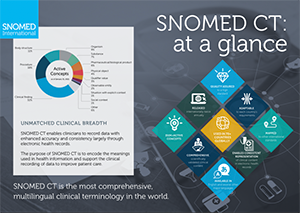
The SNOMED concept hierarchies include: Clinical finding, Procedure, Body structure, Organism, Substance, Pharmaceutical/biologic product, Specimen, Special concept, Linkage concept, Physical force, Event, Environment or geographical location, Social context, Situation with explicit context, Staging and scales, Physical object, Qualifier value and Record artifact.
Here is a SNOMED concept and two of its synonyms, along with their respective description IDs:
Myocardial infarction (disorder): 22298006
- Cardiac infarction: 37442013
- Heart attack: 37443015
Support for multiple levels of granularity allows SNOMED CT to be used to represent clinical data at a level of detail that is appropriate to a range of different uses." (SNOMED User's Guide)
Concepts with different levels of granularity are linked to one another by "is a" relationships, like in UML modeling. A terrier is a type of dog. A rigatoni is a type of pasta. This enables appropriate aggregation of specific information within more detailed categories.
Relationships link concepts in SNOMED CT. There are four types of Relationships that can be assigned to concepts in SNOMED CT:
Myocardial infarction (disorder): 22298006
- Defining
- Qualifying
- Historical
- Additional